

Two researchers from the Horizon Europe–funded MARS: Non-Western Migration Regimes in a Global Perspective project—Dr. Rustamjon Urinboyev and Dr. Sherzod Eraliev—participated online in the International Scientific and Practical Conference “Ensuring the Rule of Law in the Context of Modern Challenges: Problems and Solutions”, held on 27–28 November 2025.
The conference was organized by the Law Enforcement Academy of the Republic of Uzbekistan, with support from international organizations, and took place at the Academy’s campus in Tashkent (Yunusabad District, Rikhsiliy Street 9). The event gathered scholars, practitioners, and experts to discuss contemporary governance issues and the evolving legal challenges facing states today.
Representing the MARS project and Lund University’s Department of Sociology of Law,
Dr. Rustamjon Urinboyev delivered a presentation titled “Smartphone Transmobility: Everyday Transnational Life of Uzbek Migrants in Russia and Turkey.” His talk examined how digital technologies facilitate cross-border mobility, shape migrants’ perceptions of justice and opportunity, and influence the comparative experiences of Uzbek workers in Russia and Türkiye.
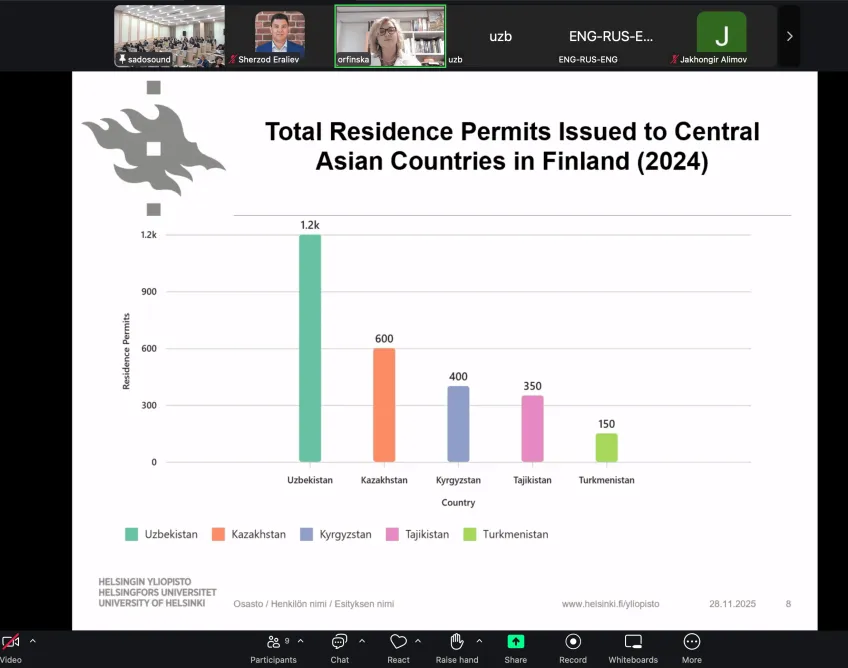
Dr. Sherzod Eraliev, Associate Professor at Lund University and the Aleksanteri Institute (University of Helsinki), presented “Changing Migration Flows: Mobility of Central Asian Populations between Russia and Northern Europe.” He analysed emerging migration shifts driven by geopolitical tensions, evolving labour conditions, and the reorientation of post-Soviet mobility toward Northern European destinations.

Together, their contributions highlighted how digital communication, legal environments, and geopolitical dynamics are reshaping migration routes within and beyond Eurasia. Their participation underscores the MARS project’s commitment to advancing evidence-based, non-Western perspectives in global migration research and to supporting international dialogue on migration and governance.